 Alfred Black
Claude and ChatGPT have gotten very good at tasks. Ask for a proposal, a summary or a plan, and you get something good in seconds.
But your job isn't a pile of tasks. Your job is knowing what you promised, to whom, what changed since, and what's still open. That part still lives in your head. So before every call you spend half an hour rebuilding it: reading old threads, scrolling transcripts, checking what you said last time.
I call this the reconstruction tax. If you run a business on your own attention, it's the biggest bill you pay. Nobody sends you an invoice for it.
Agents have a state problem
Every AI session starts from zero. You bring the context, the agent does the work, the session ends. Tomorrow you bring the context again.
Memory doesn't fix this. Memory remembers what was said. State knows what is true right now:
- what you promised, and to whom
- what is actually done, and what an agent only says is done
- what you're waiting on, and from whom
- what changed since you last looked
Your AI has memory. Nobody holds the state. So you do.
- PromisedYou said you’d connect it.1Call · 28 Jul
- ConnectedProves the connection. Not that they’re happy with it.2Brief · 8 Sep
- AcceptedWaiting on their OK. Next: ask them.
That's how capable people end up managing agents instead of people: prompting, checking, correcting and fixing, on top of the work itself. Your AI subscription has a second bill hidden inside it, and you pay it in time. Most people never see it written down.
Alfred keeps the state
Alfred is a management layer for your AI. It doesn't do your tasks. Claude and ChatGPT are very good at that, and you should keep using them. Claude does the task. Alfred knows the job.
It follows the places your work happens, the ones you choose: email, calendar, calls, chats. From them it keeps a current record of each thing that matters to you. Every client, every project, every area you're responsible for. Each record holds the people, the promises, the open questions and the time spent.
When sources disagree — a launch date in an email that doesn't match the calendar — Alfred catches it and shows you exactly where. It holds every commitment you've made, tracks what's still open, and keeps your todo list for you, on autopilot.
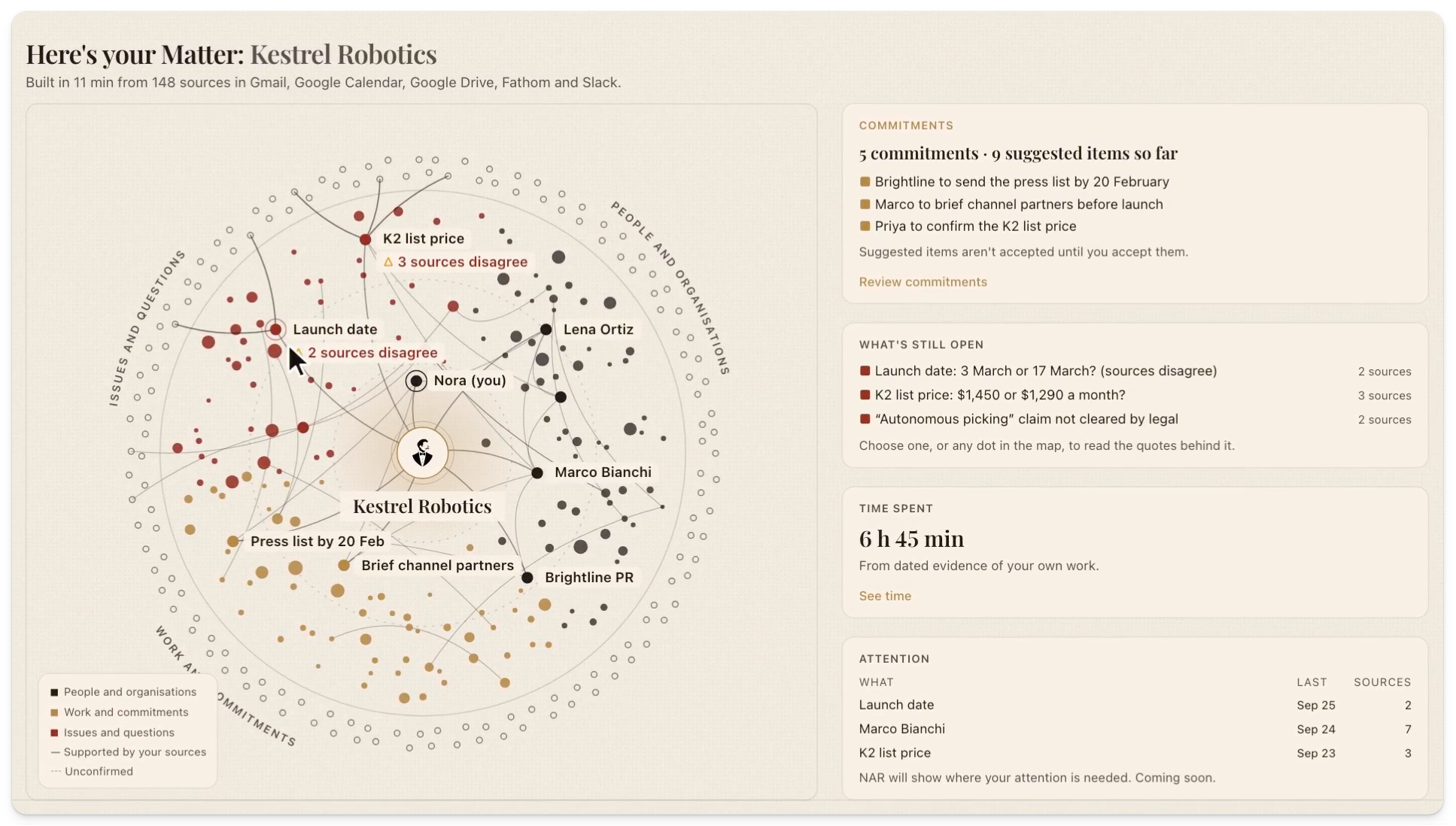
Every morning you get a short brief: what changed, what's due, what needs you. A few items come as approve or deny. Everything else stays quiet. You keep working where you already work.
The rules it's built on
Rather than give you a feature list, here are the three rules Alfred is built on.
- Every change cites its source. When Alfred updates a record, it points to the exact words behind it: the email, the line in the transcript. If it can't, the change waits for you.
- Done isn't delivered. An agent saying it finished doesn't count. Neither does a meeting summary. Work is done when there's evidence, and delivered when the other side accepts it. Unknown stays unknown.
- Your attention is the scarce thing. More agents shouldn't mean more noise. Alfred's default is silence. It interrupts you only for what needs your judgment.
What I'm not building
- Another chatbot. You don't talk to Alfred. You keep using Claude or ChatGPT, and Alfred works in the background.
- A memory feature. Remembering conversations isn't the problem. Knowing what's true is.
- An autopilot. Alfred starts by reading, not acting. It earns the right to act one kind of task at a time. It never makes legal or financial commitments for you.
- A walled garden. Your records and your AI plan stay yours. Nothing gets locked inside Alfred.
The record
My name is David. I've built 4 tech companies since 2012 and now run a small fractional CTO practice from home. I run my entire life through Alfred from work to health, even my hobbies are being looked after by it.
I've been tracking the time Alfred's management gives me back. On average this comes out at 70 hours a month.
That number is net.1 I subtract the time I spend prompting it, checking its work, fixing its mistakes and being interrupted by it. Work I rejected counts as zero. Work I'd never have done anyway doesn't count at all.
I publish the numbers regularly on my YouTube channel. Watch the video below to see how Alfred gave me back 124 hours in 45 days.
Who is Alfred for?
- People who run a business on their own attention: independent advisers, consultants, fractional executives. Usually a small team or none, and many client relationships at once.
- You already use Claude or ChatGPT, and it isn't saving you the time it should.
- If your problem is finding clients, Alfred won't help. It's built for people with more work than attention.
- Today, Alfred works on a Mac.
Getting started
- I'm opening access in small groups, so thank you for your patience.
- If you fit the description above, answer a few quick questions after you sign up. Those people go first.
- Once you're in, you will be invited to download Dossier, a macOS app for Alfred to learn about you.
- The details come by email when it's your turn.
I'll only use your email for access to Alfred.